Showing posts with label Peoplesoft HRMS. Show all posts
Showing posts with label Peoplesoft HRMS. Show all posts
Sunday, November 4, 2012


Sunday, February 12, 2012
Another one in the Oracle hat - TALEO
In another significant move at consolidation of the HR Technology space - Taleo announced three days back that it had entered into an agreement with Oracle to be acquired by the latter. Leaving the 'cloud' argument aside, what excites me most about this acquisition is that the Oracle HCM suites will now have a leading ATS to offer their clients. Over the last few years I have seen customers sideline the entire PeopleSoft e-recruitment module and opting to implement a specialized recruitment software like Taleo or SuccessFactors. The Oracle HCM solution offering will surely be more comprehensive by this acquisition and that is indeed good news for all Oracle HCM customers!
Wednesday, November 30, 2011
PeopleSoft HCM Fundamental Tables - Flash Cards
Presenting easy to use flash cards for revising the most important list of tables in PeopleSoft Workforce Administration

Saturday, August 27, 2011
Sneak peek into Fusion HCM
Got to attend a Fusion HCM demo couple of days back and I have to say that I was left extremely impressed with the features on offer. Here are some of the points that struck me, which I feel will go a long way in establishing Fusion as a strong contender in the HCM marketplace:
 1. Excellent inbuilt and graphical analytics including predictive analytics with a first of its kind module called Workforce Predictions.
2. A wide variety of hosting options including on-premise, public cloud, private cloud etc.
3. Excellent User Interfaces and integrated web2.0 features. As we all know, the fusion team has put a lot of research and emphasis on the UI and it really looks very impressive.
4. Plug and use compatibility with other Oracle HRMS suites like PeopleSoft, e-biz, JD Edwards etc.
5. The various modules seemed to be integrated with respect to analytics and presentation rather than being individual silos - thus giving organizations a comprehensive view of it's people.
All in all, the features on display in the demo (need to put the disclaimer that it was just a prepared demo!) were extremely impressive and somehow I feel that Fusion HCM is going to make a sizeable dent in the HCM market space.
 1. Excellent inbuilt and graphical analytics including predictive analytics with a first of its kind module called Workforce Predictions.
 2. A wide variety of hosting options including on-premise, public cloud, private cloud etc.
3. Excellent User Interfaces and integrated web2.0 features. As we all know, the fusion team has put a lot of research and emphasis on the UI and it really looks very impressive.
4. Plug and use compatibility with other Oracle HRMS suites like PeopleSoft, e-biz, JD Edwards etc.
5. The various modules seemed to be integrated with respect to analytics and presentation rather than being individual silos - thus giving organizations a comprehensive view of it's people.
All in all, the features on display in the demo (need to put the disclaimer that it was just a prepared demo!) were extremely impressive and somehow I feel that Fusion HCM is going to make a sizeable dent in the HCM market space.
Sunday, April 4, 2010
Absence Leakage Decision Chart
Praveen was visibly frustrated, well not without reason, as the lead Absence Management consultant he was bombarded with multiple calls from the business team - most of them talking about the same issue of users having reported absences but the same not getting paid out in payroll. These issues were serious because it affected the pay of the employees and had to be investigated on priority and it took a good half day to investigate, document and communicate the fix to the users (even though he was an expert in the module!). Couple of months into this routine, Praveen realised that better user training and tools could help HR users to troubleshoot this issue at the first level itself and he decided to prepare a decision chart for the same.
Praveen had long realised that Peoplesoft absence management was a complex module for business users to comprehend and better tools and charts were required to simplify navigation through the module. He conceptualised a simple seven step process to help users identify where the booked absence went missing. The below presentation details the decision chart prepared by Praveen:
As a matter of fact, not even a single call came to the IT team regarding missing absences after introducing this tool and Praveen has been smiling since then!!
Well, even today most customers and users are trying hard to wade through the issues and complexities presented by Peoplesoft Absence Management and does not have any tool or dashboard to see what is actually being paid out and whether any payroll over or underpayments are being made. If you feel you fall under this category of customers and would want better auditing and dashboards to track your Peoplesoft Time and Attendance and Payroll systems, it is time to get in touch with us!
Praveen had long realised that Peoplesoft absence management was a complex module for business users to comprehend and better tools and charts were required to simplify navigation through the module. He conceptualised a simple seven step process to help users identify where the booked absence went missing. The below presentation details the decision chart prepared by Praveen:
Peoplesoft Absence Leakage Decision Chart
View more presentations from jijucvengal.
As a matter of fact, not even a single call came to the IT team regarding missing absences after introducing this tool and Praveen has been smiling since then!!
Well, even today most customers and users are trying hard to wade through the issues and complexities presented by Peoplesoft Absence Management and does not have any tool or dashboard to see what is actually being paid out and whether any payroll over or underpayments are being made. If you feel you fall under this category of customers and would want better auditing and dashboards to track your Peoplesoft Time and Attendance and Payroll systems, it is time to get in touch with us!
Thursday, April 1, 2010
After a long hiatus - Looking up to 2010!
Time lost is lost forever - true and I've had three full months without any new posts....Personally it's been an exciting period for me - moving out of the lax groove of bachelorhood, being married to the woman I love and finding that the 'life' in 'work-life balance' indeed does exist!
Eventhough it's three months into the new year, let me wish all of you a wonderful year ahead - a year full of new and fruitful experiences and learning!
I am sure that 2010 is going to be more exciting than the last two years which saw companies freezing investment on HR projects eclipsed by the worst recession since 1930s. Things have already started to look up - companies are hiring Peoplesoft consultants in scores and dozens, organisations have lapped up version 9.1 in a big way and HRIT projects seem to be getting favour once again!
So, what is going to be my theme and focus in the year ahead? Undoubtedly it's got to be about finding better ways to give customers a better deal in Peoplesoft Time and Pay implementations. I believe it's time for us to offer specialised and holistic solutions in this space to our customers and look beyond words like 'deployment' or 'implementation'. Undoubtedly, any time and pay HR suite (includes Time and Labor, Absence Management and Payroll solutions) has a direct impact on the company's financials and it's extremely critical to get it right the first time. I am convinced that we have a long way to go in this space - simply implementing certain modules will not work in this case as any time and pay implementation requires extensive integration between the modules as well as with external systems, requires tight audits and most importantly, the real life scenarios are extremely difficult to simulate in a test environment. I will not be exaggerating when I say that there are a number of customers out there who are bleeding thousands of dollars every pay period due to the issues with their time and pay systems - don't they require a better deal? I am convinced that they do and it will be difficult to achieve that with the current approach to Peoplesoft implementation.
My focus over the next few months will be on conceptualising a better framework and approach to time and pay system adoption and this blog will be my mouthpiece!
Eventhough it's three months into the new year, let me wish all of you a wonderful year ahead - a year full of new and fruitful experiences and learning!
I am sure that 2010 is going to be more exciting than the last two years which saw companies freezing investment on HR projects eclipsed by the worst recession since 1930s. Things have already started to look up - companies are hiring Peoplesoft consultants in scores and dozens, organisations have lapped up version 9.1 in a big way and HRIT projects seem to be getting favour once again!
So, what is going to be my theme and focus in the year ahead? Undoubtedly it's got to be about finding better ways to give customers a better deal in Peoplesoft Time and Pay implementations. I believe it's time for us to offer specialised and holistic solutions in this space to our customers and look beyond words like 'deployment' or 'implementation'. Undoubtedly, any time and pay HR suite (includes Time and Labor, Absence Management and Payroll solutions) has a direct impact on the company's financials and it's extremely critical to get it right the first time. I am convinced that we have a long way to go in this space - simply implementing certain modules will not work in this case as any time and pay implementation requires extensive integration between the modules as well as with external systems, requires tight audits and most importantly, the real life scenarios are extremely difficult to simulate in a test environment. I will not be exaggerating when I say that there are a number of customers out there who are bleeding thousands of dollars every pay period due to the issues with their time and pay systems - don't they require a better deal? I am convinced that they do and it will be difficult to achieve that with the current approach to Peoplesoft implementation.
My focus over the next few months will be on conceptualising a better framework and approach to time and pay system adoption and this blog will be my mouthpiece!
Wednesday, August 5, 2009
Deciphering the skeleton of Peoplesoft HRMS modules
The more I get to work on various modules, the more I find similarities between their basic architecture. For example, sample the architectural similarity between Payroll for North America, Time and Labor and Absence Management.
NA Payroll T&L Absence Management
Paygroups Workgroups GP Paygroups
Earning Program TRC Program Element Group
Earnings/Deductions TRCs Absence Takes
Calendars NA Calendars
Pay Run ID NA Calendar Run ID
Company NA Pay Entity
NA T&L Rules Formulas
It has also been my experience that almost all modules in Peoplesoft HRMS is designed to link the smallest functional unit of that module to the employee. For example, the smallest unit in T&L in TRC and everything that we do in Time and Labor is designed to link the correct TRC and quantity to an employee. The same would be the case for Absence Management and NA Payroll where the smallest unit would be an Absence Take and Earnings/Deductions respectively. Once you have this fundamental understanding, everything else will automatically fall in place.
Another powerful analogy is to an inverted pyramid where the smallest unit of the module will be at the tip at the bottom and the employee on the flat base at the top. The architecture of most modules I know builds up like an inverted pyramid from the smallest unit to aggregate in size and finally attach itself to an employee.
A simple example from Time and Labor would be the case of how a TRC is linked to an employee. At the bottom of the pyramid there is the TRC, above that is the TRC Program, above that there is the workgroup and finally at the base there is the employee. You can seamlessly extend this analogy to other modules as well.
Another powerful analogy is to an inverted pyramid where the smallest unit of the module will be at the tip at the bottom and the employee on the flat base at the top. The architecture of most modules I know builds up like an inverted pyramid from the smallest unit to aggregate in size and finally attach itself to an employee.
A simple example from Time and Labor would be the case of how a TRC is linked to an employee. At the bottom of the pyramid there is the TRC, above that is the TRC Program, above that there is the workgroup and finally at the base there is the employee. You can seamlessly extend this analogy to other modules as well.
Saturday, July 4, 2009
Best Peoplesoft Time and Labor blog?
This might sound vane, but according to the Google Search engines you are now reading the best blog on Peoplesoft Time and Labor!
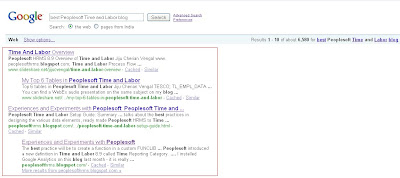
While I know that's an insignificant indicator to be proud about, but I hope that my posts have been helpful to consultants seeking information on Peoplesoft HRMS and Time and Labor in particular. I started this blog in 2008 primarily to try my part in filling the lack of quality reference materials available for Peoplesoft functional modules and after being appalled at the prohibitive cost of the training courses available for the product. Do let me know your comments and suggestions to improve the content of this blog and keep those visits coming!!

While I know that's an insignificant indicator to be proud about, but I hope that my posts have been helpful to consultants seeking information on Peoplesoft HRMS and Time and Labor in particular. I started this blog in 2008 primarily to try my part in filling the lack of quality reference materials available for Peoplesoft functional modules and after being appalled at the prohibitive cost of the training courses available for the product. Do let me know your comments and suggestions to improve the content of this blog and keep those visits coming!!
Search Page security in Peoplesoft Time and Labor
I had detailed how Time and Labor security works in a previous post and today I want to touch upon how customers can configure the security on the Manager Self Service and Administrators for Time and Labor. Currently, there are three distinct ways of configuring search page security in Peoplesoft (including Time and Labor):
1. Use the highly robust and modified Core Row Level security, where any level of flexible security definition can be created with the introduction of Security Access Types in Peoplesoft HRMS 8.9.
2. Use the Direct Reports functionality which most of the MSS pages of Absence Management and e-Performance make use of. This feature will provide a standard page containing the direct reports of a user.
3. Use Time and Labor security to show to users employees in the Static and Dynamic groups that they have access to.
(You can also enforce search security through Search Init peoplecode, but this approach is highly discouraged.)
Most organisations will be designing their search security by making use of the new Row Level security design and in this context, a debatable question is whether we need to use Time and Labor security itself? Also, a number of people ask whether we can use Row Level security for the Time and Labor search pages, or whether it can make use of only Time and Labor security.
The answer is provided by the below decision chart (click on the picture to see a larger view):
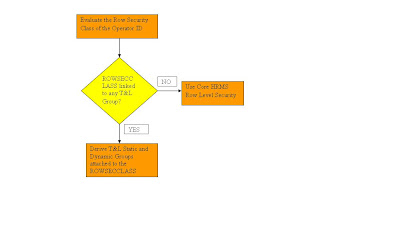 All the Search pages in Time and Labor is flexible enough to utilize both Time and Labor security and core Row Level security. This decision depends on how the rowsecclass attached to a user is configured. If the rowsecclass is attached to any Time and Labor group (this can be found from the table PS_TL_GRP_SECURITY), then the user will be able to see only employees belonging to the groups the user's rowsecclass has access to. On the other hand, if there are no Time and Labor groups attached to the rowsecclass of the user, then core row level security available for the user will be used to fetch the employees.
What should be the optimum Time and Labor search security strategy?
If your organisation is using other Peoplesoft HRMS modules then it is best to utilise a common security design for all the modules. So I will always suggest using row level security for Time and Labor pages and not to configure any extra Time and Labor groups for the purpose of row level security.
Time and Labor groups can be created for the purpose of batch processing of employees. It is very useful to create Time and Labor groups and use the group as an input parameter for the Time Administration or Batch Approval or Batch Schedule Assignment processes. Note that a Time and Labor group can be defined without linking it to any row security class and used solely for the purpose of grouping employees together.
1. Use the highly robust and modified Core Row Level security, where any level of flexible security definition can be created with the introduction of Security Access Types in Peoplesoft HRMS 8.9.
2. Use the Direct Reports functionality which most of the MSS pages of Absence Management and e-Performance make use of. This feature will provide a standard page containing the direct reports of a user.
3. Use Time and Labor security to show to users employees in the Static and Dynamic groups that they have access to.
(You can also enforce search security through Search Init peoplecode, but this approach is highly discouraged.)
Most organisations will be designing their search security by making use of the new Row Level security design and in this context, a debatable question is whether we need to use Time and Labor security itself? Also, a number of people ask whether we can use Row Level security for the Time and Labor search pages, or whether it can make use of only Time and Labor security.
The answer is provided by the below decision chart (click on the picture to see a larger view):
 All the Search pages in Time and Labor is flexible enough to utilize both Time and Labor security and core Row Level security. This decision depends on how the rowsecclass attached to a user is configured. If the rowsecclass is attached to any Time and Labor group (this can be found from the table PS_TL_GRP_SECURITY), then the user will be able to see only employees belonging to the groups the user's rowsecclass has access to. On the other hand, if there are no Time and Labor groups attached to the rowsecclass of the user, then core row level security available for the user will be used to fetch the employees.
What should be the optimum Time and Labor search security strategy?
If your organisation is using other Peoplesoft HRMS modules then it is best to utilise a common security design for all the modules. So I will always suggest using row level security for Time and Labor pages and not to configure any extra Time and Labor groups for the purpose of row level security.
Time and Labor groups can be created for the purpose of batch processing of employees. It is very useful to create Time and Labor groups and use the group as an input parameter for the Time Administration or Batch Approval or Batch Schedule Assignment processes. Note that a Time and Labor group can be defined without linking it to any row security class and used solely for the purpose of grouping employees together.
Wednesday, April 22, 2009
Peoplesoft Time and Labor: My wishlist - I
I believe that Peoplesoft has done an awesome job with the Time and Labor product - it's flexibility, features and strong integration capabilities make it a very strong product that caters very well to most business needs. Yet, there are some areas I wish Oracle could improve upon, some features that I sorely miss and so here is my wish list for a future release of Time and Labor.
> Integration with HRMS: It is critical that Time and Labor data is kept in sync with the HRMS data. Most implementations require the development of a process to do this, considering the inevitability of this process, it will be a relief for customers to have this as a delivered process.
> Restore Feature on Timesheet: There should be a feature to restore the timesheet to the last saved state. This will be a usability improvement and a much asked one by many customers I've worked with.
> Online Rules as Validation Messages: There is a delivered feature that allows the users to execute Time and Labor rules on the timesheet, but unfortunately this process just generates exceptions. It would be more meaningful and helpful if these online rules could be thrown up as a validation/error message. Most implementations require varying degree of online validations during time entry - it would be great to have those configured as T&L rules rather than through Peoplecode as T&L rules can be configured from the PIA and will not have to disturb any delivered component.
> Performance Improvement: Performance is a real issue with Time and Labor. Oracle needs to take a good look at both online performance (some of the delivered pagelets perform so poorly that they cannot be used at all!) as well as that of batch jobs like Time Administration.
> Mass Upload time through spreadsheet: It would be a nice to have feature to have a page from where users can directly upload reported time from a spreadsheet. Even though Time and Labor comes with the Rapid Time feature, there is nothing like working directly with an excel worksheet!
> More Delivered Reports: Customers would love to have more delivered reports with the product. Reports on employee schedules, reported time-payable time reconciliation, absence data-reported time reconciliation etc. would be a run away hit amongst the customers.
> T&L Rule Migration Engine: Modelled in a way similar to the Rule Packager utility in Absence Management, Time and Labor should also have a simple engine to aid in the migration of T&L Rules from one environment to another.
> Manager Dashboard: As Time and Labor data talks a lot about employee productivity and discipline, it would be wonderful to have a Manager Dashboard pagelet with analysis on Employee attendance information, Employee punctuality, Overtime and Productivity, Absenteeism etc.
> Delivered Localised Rules: Similar to the country extensions of GP that cater to the local country taxation and payroll rules, it would be a wonderful idea for Oracle to deliver Time and Labor with local rules of countries/cities. Some countries and cities have mandatory time and labor rules which every organisation will have to follow and there is nothing like getting that delivered with the product. The development, testing and maintenance time that this will save is immense for customers to readily lap up this feature.
If Oracle is reading, I am sure that some of these changes will go a long way in making Time and Labor a stronger product and the developer and user community would love to see some of these propping in to future releases.
> Restore Feature on Timesheet: There should be a feature to restore the timesheet to the last saved state. This will be a usability improvement and a much asked one by many customers I've worked with.
> Online Rules as Validation Messages: There is a delivered feature that allows the users to execute Time and Labor rules on the timesheet, but unfortunately this process just generates exceptions. It would be more meaningful and helpful if these online rules could be thrown up as a validation/error message. Most implementations require varying degree of online validations during time entry - it would be great to have those configured as T&L rules rather than through Peoplecode as T&L rules can be configured from the PIA and will not have to disturb any delivered component.
> Performance Improvement: Performance is a real issue with Time and Labor. Oracle needs to take a good look at both online performance (some of the delivered pagelets perform so poorly that they cannot be used at all!) as well as that of batch jobs like Time Administration.
> Mass Upload time through spreadsheet: It would be a nice to have feature to have a page from where users can directly upload reported time from a spreadsheet. Even though Time and Labor comes with the Rapid Time feature, there is nothing like working directly with an excel worksheet!
> More Delivered Reports: Customers would love to have more delivered reports with the product. Reports on employee schedules, reported time-payable time reconciliation, absence data-reported time reconciliation etc. would be a run away hit amongst the customers.
> T&L Rule Migration Engine: Modelled in a way similar to the Rule Packager utility in Absence Management, Time and Labor should also have a simple engine to aid in the migration of T&L Rules from one environment to another.
> Manager Dashboard: As Time and Labor data talks a lot about employee productivity and discipline, it would be wonderful to have a Manager Dashboard pagelet with analysis on Employee attendance information, Employee punctuality, Overtime and Productivity, Absenteeism etc.
> Delivered Localised Rules: Similar to the country extensions of GP that cater to the local country taxation and payroll rules, it would be a wonderful idea for Oracle to deliver Time and Labor with local rules of countries/cities. Some countries and cities have mandatory time and labor rules which every organisation will have to follow and there is nothing like getting that delivered with the product. The development, testing and maintenance time that this will save is immense for customers to readily lap up this feature.
If Oracle is reading, I am sure that some of these changes will go a long way in making Time and Labor a stronger product and the developer and user community would love to see some of these propping in to future releases.
Subscribe to:
Posts (Atom)