Watch details of the verdict against SAP to pay $1.3 billion to Oracle for IP violations done by Tomorrownow, which SAP acquired in 2005:
Friday, November 26, 2010


Monday, October 25, 2010
What about a PeopleSoft App Store?
I've been mulling the idea of having an app store for PeopleSoft applications, similar to the Apple app store. Wouldn't it be great to have an online store where developers can upload bolt-on pieces and applications that have been created which customers can download and install in their PeopleSoft systems? I know that this is completely different from a typical ERP solution delivery, but I envision that such a concept will greatly help in enhancing PeopleSoft's popularity among customers. Fundamentally, this will also breed a group of developers or companies which would be pure app/product developers and I am sure that PeopleSoft customers will get to have some high quality add-ons which will enhance the usability experience. I am sure that this will happen some time, some day!
Sunday, October 17, 2010
Roadmap for PeopleSoft HCM product line

Figure 1: Adoption rate comparison between 9.1 and 9.0

Figure 2: Investment strategy on PeopleSoft product line - 9.2, 9.3 etc.

Saturday, October 16, 2010
Enterprise Time and Attendance product challenges
Most enterprise Time and Attendance systems (by enterprise T&A systems, I refer to time and attendance modules present in the larger HCM product line of an ERP suite and not stand alone time and attendance products) are mature products doing a very fine job of collecting and processing time. But recent advances in technology as well as changing patterns of employment and workforce present some very interesting challenges to traditional established Enterprise Time and Attendance softwares. An enterprise Time and Attendance system can no longer survive with a one-product-in-all strategy, simply because other systems have evolved over the last many years which are capable of performing certain aspects of time management much better than an enterprise Time and Attendance system. One of the major trends shaping the workforce today is the paradigm of the mobile/flexible workforce and the widespread influence of mobile devices and social networking. What is the best way to report/record time for a mobile workforce, living in the virtual social networking world? It is my solemn belief that the interface to report time will move to mobile devices or even social networking sites (think of recording an absence from a Facebook app! Weird, but in the current context an absolute probability) and the role of an enterprise Time and Attendance software as a time recording tool will fade to insignificance. To enable this shift, enterprise time and attendance products should come up with robust APIs for time reporting which any third party can consume and use.
Another major shift is in data analytics - traditionally time and attendance softwares come with very minimal data crunching and reporting abilities, while one of the major advantages of a T&A system is the insights time data can give into labour productivity and payroll costs. This is also a task better done by specialized data warehousing products, rather than the T&A product. This also makes sense as organizations are moving towards an integrated data warehousing strategy.
In short - enterprise time and attendance systems will mostly assume the role of a time processing engine and act as the critical bridging point between the time reporting layer and the reporting/analytics and other enterprise components like payroll and workforce scheduling systems. Below are my predictions on how enterprise T&A modules will evolve to meet the new challenges:

Another major shift is in data analytics - traditionally time and attendance softwares come with very minimal data crunching and reporting abilities, while one of the major advantages of a T&A system is the insights time data can give into labour productivity and payroll costs. This is also a task better done by specialized data warehousing products, rather than the T&A product. This also makes sense as organizations are moving towards an integrated data warehousing strategy.
In short - enterprise time and attendance systems will mostly assume the role of a time processing engine and act as the critical bridging point between the time reporting layer and the reporting/analytics and other enterprise components like payroll and workforce scheduling systems. Below are my predictions on how enterprise T&A modules will evolve to meet the new challenges:
- Separation of time reporting layer and time processing layer. Time reporting layer will move out of the enterprise T&A product, while the core strength of the T&A product will be time processing.
- APIs for integrating time data with time reporting interfaces. This should enable organizations the flexibility to report time using any mobile/social networking utility.
- Verticalisation of time and attendance solutions. Unlike other HCM processes, time management processes vary greatly across industries and a single configurable solution does not fit well. Enterprise T&A modules will have to verticalize their solutions.
- Stronger time based reporting and analytics and APIs with data warehousing products for time analytics. As organizations are moving towards a central data warehousing tool for all products used within the organization, I would like to see enterprise T&A module vendors forging stronger alliances with datawarehousing vendors and coming up with pre-defined data models, dashboards and reports.

KABA BCOMM integration with PeopleSoft Absence Management
KABA is one of the two certified time clock vendors for Oracle PeopleSoft Time and Labor. There is a bi-directional integration between KABA and T&L, with T&L sending the TCD (Time Collection Device) and time reporter data to KABA and KABA sending the punch/elapsed time data to T&L. The integration of KABA and Time and Labor is pretty seamless and my experiences with the product has been very satisfactory. In a recent product demonstration by KABA, I got to know that they are developing an interface with PeopleSoft Absence Management, which will allow users to book absences directly on the clock. According to the KABA account manager who was giving the product overview, the integration with Absence Management should be generally available by Q2 of 2011. This is an interesting development as it will ease absence reporting for employees in operational industries (like manufacturing/retail/hospitality etc.), integrate time and absence reporting to a single application, authenticate employees based on a badge/biometric data (thereby eliminating the need for employees to remember the username and password for various applications) and possibly eliminate the need for employees to spend time in a computer kiosk (with associated authentication, caching and security concerns). But, absence reporting is completely different from time reporting and it will be interesting to see how the product from KABA is positioned to deal with all the challenges. Nevertheless, it is a feature which customers would want to evaluate while deploying PeopleSoft Time and Labor and TCDs.
Tuesday, September 7, 2010
Towards an IT Application Support Model
A proposed model for carrying out IT application support. The model has hues of Business Process Management and emphasizes on a phased maturity leading to business transformation. Business transformation is not a process that has to wait till an application upgrade (from an ERP perspective), especially in an age where the rate of change of technology is tightly intertwined with changes in the way business is done. This is exactly why we need to move from an IT support model that measures IT and Business continuity and SLA adherence, to a model that leverages information technology for changing ways business is done.
Towards an it support model
Towards an it support model
View more presentations from jijucvengal.
I have specific ideas from a PeopleSoft HCM perspective around moving towards Orbit 3 and would be more than willing to share and build the same with anyone who is interested!
I have specific ideas from a PeopleSoft HCM perspective around moving towards Orbit 3 and would be more than willing to share and build the same with anyone who is interested!
Wednesday, August 25, 2010
GP Formula Text Builder
The application package GP_FORMULA_PARSER can be utilized to generate the Formula Text of a Global Payroll or Absence Management formula. This is the base package that is used in the formula definition page as well as in the rule package compare utility, to expand the seemingly 'cryptic' GP formulae. The method ConvertRowsetToText takes the GP_FORMULA_DTL rowset as one of the input parameters and returns a string containing the parsed formula definition. The only problem I found with the output was that it contained HTML tags which had to be stripped off for use in a non-HTML context. This can be a very handy utility to quickly generate the formulae text for comparison and documentation purposes.
Friday, August 6, 2010
Reusable methods in Peoplesoft Time and Labor and Absence Management - 9.0/8.49.15
I have compiled a short list of delivered methods in application packages for both T&L and Absence Management. I believe that it is important that developers know and understand these methods as it can be reused to save development effort as well as increase quality of coding. You can find the list in the below location:
Time and Labor Methods for Reuse
Time and Labor Methods for Reuse
Sunday, May 2, 2010
Recruitment Solutions and Social Networking
A major feature that separates the recruitment business functionality from other HR business areas is the fact that it interacts heavily with people outside the organisation through external job postings, career sites, job boards etc. Reaching out to the right candidates with information regarding open positions is thus a strategic challenge for the recruitment function. With the almost cultural assimilation of social networking tools across the world, it would be anachronistic to stick to the old world strategy of posting job openings in career sites and job portals alone. The use of social networking tools in recruitment is well documented and more and more organisations are relying on LinkedIn, Facebook, Blogger and Orkut to zero in on desired candidates.
I strongly believe that software used for recruitment should have a strong social networking component to it for organisations to truly achieve a higher ROI on their investments. It's imperative that the organisation reaches out to potential candidates through this channel and further utilize the wealth of information that is present in these tools to screen candidates further.
I want to present two ideas I have in this regard and hope that organisations will be able to build further on them to achieve higher ROI on their recruitment systems:
1. Job postings to Twitter: In a latest survey, a whopping 87% of Americans have heard of Twitter! Another staggering fact is that close to 50 million (yes you heard it right!) tweets are generated each day (that is close to 600 tweets in a second). Another significant statistic is that close to 50% of Twitter users are from USA. Considering all of this and especially if your company is look at talent in the US, your organisation has to seriously look at leveraging Twitter to reach out to potential applicants. Now, how does it all relate to Peoplesoft? Well, if you are using Peoplesoft Recruitment solutions then I propose that you integrate that with Twitter to enable external job postings created in Peoplesoft to be posted as tweets. This should be part of a larger recruitment marketing strategy of using Social Networking sites to position your organisation as a preffered employer. There are a number of APIs (including this Javascript API that can be utilized in Peoplesoft) that can be utilized to integrate Peoplesoft and Twitter. The simplest start though is to use Twitter Mail (a third party application that posts emails as tweets) which your Peoplesoft technical team should be able to implement in quick time.
2. Enterprise Applicant profile aggregation tool: I envisage a tool that will crawl various social networking sites to aggregate a 'social networking' profile of a candidate which can be further utilized in the selection process. In an excellent paper, Sam Gosling of the Department of Psychology, University of Texas, Austin and others have claimed that Online Social Networking Website (OSNW) profiles provide more information regarding the personality of an individual than most other sources, including physically meeting the individual. I am convinced that an aggregated social networking profile of an individual will greatly help organisations assess the fit of the person to the ethos of the company and make more accurate hiring decisions. It would be wonderful to have a tool (which can further be embedded in the recruitment module) that will create such a profile and may be even draw up personality traits of individuals from the profile information. There are arguments against the use of OSNW profiles to select/reject candidates, but I am of the opinion that an aggregator written for enterprise use can be used as a decision enabler in the recruitment process. (A number of social networking aggregators exist in the market, but I do not think any of them can be utilized for enterprise use. The ideal enterprise aggregator should not just be a mashup product, but should utilize research in social psychology, human behaviour etc. to identify patterns and personality traits through social networking profiles).
A typical issue with large ERP products like Oracle Peoplesoft is it's lack of flexibility to adapt to changing business environments (well a new release comes out just once in two years or more!!) and any call for large scale customizations would again create issues with upgrade! But, while the entire industry is caught in that conundrum, I see no point in being rigid and missing critical opportunities to take your business to the next level. Are you getting the right ROI on your HR systems or is it a large clumsy dino?
I strongly believe that software used for recruitment should have a strong social networking component to it for organisations to truly achieve a higher ROI on their investments. It's imperative that the organisation reaches out to potential candidates through this channel and further utilize the wealth of information that is present in these tools to screen candidates further.
I want to present two ideas I have in this regard and hope that organisations will be able to build further on them to achieve higher ROI on their recruitment systems:
1. Job postings to Twitter: In a latest survey, a whopping 87% of Americans have heard of Twitter! Another staggering fact is that close to 50 million (yes you heard it right!) tweets are generated each day (that is close to 600 tweets in a second). Another significant statistic is that close to 50% of Twitter users are from USA. Considering all of this and especially if your company is look at talent in the US, your organisation has to seriously look at leveraging Twitter to reach out to potential applicants. Now, how does it all relate to Peoplesoft? Well, if you are using Peoplesoft Recruitment solutions then I propose that you integrate that with Twitter to enable external job postings created in Peoplesoft to be posted as tweets. This should be part of a larger recruitment marketing strategy of using Social Networking sites to position your organisation as a preffered employer. There are a number of APIs (including this Javascript API that can be utilized in Peoplesoft) that can be utilized to integrate Peoplesoft and Twitter. The simplest start though is to use Twitter Mail (a third party application that posts emails as tweets) which your Peoplesoft technical team should be able to implement in quick time.
2. Enterprise Applicant profile aggregation tool: I envisage a tool that will crawl various social networking sites to aggregate a 'social networking' profile of a candidate which can be further utilized in the selection process. In an excellent paper, Sam Gosling of the Department of Psychology, University of Texas, Austin and others have claimed that Online Social Networking Website (OSNW) profiles provide more information regarding the personality of an individual than most other sources, including physically meeting the individual. I am convinced that an aggregated social networking profile of an individual will greatly help organisations assess the fit of the person to the ethos of the company and make more accurate hiring decisions. It would be wonderful to have a tool (which can further be embedded in the recruitment module) that will create such a profile and may be even draw up personality traits of individuals from the profile information. There are arguments against the use of OSNW profiles to select/reject candidates, but I am of the opinion that an aggregator written for enterprise use can be used as a decision enabler in the recruitment process. (A number of social networking aggregators exist in the market, but I do not think any of them can be utilized for enterprise use. The ideal enterprise aggregator should not just be a mashup product, but should utilize research in social psychology, human behaviour etc. to identify patterns and personality traits through social networking profiles).
A typical issue with large ERP products like Oracle Peoplesoft is it's lack of flexibility to adapt to changing business environments (well a new release comes out just once in two years or more!!) and any call for large scale customizations would again create issues with upgrade! But, while the entire industry is caught in that conundrum, I see no point in being rigid and missing critical opportunities to take your business to the next level. Are you getting the right ROI on your HR systems or is it a large clumsy dino?
Invalid Date in function AddToDate - A common T&L error
A common error you encounter in a fresh environment while accessing T&L pages is shown below:
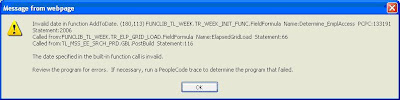
This error occurs due to the T&L Dates table and T&L Calendar tables not being built for the period in question.
Use the Build Time Period Calendar process available in the following navigation to build calendars for the concerned date:
Setup HRMS --> Product Releated --> Time and Labor --> Periods --> Build Time Period Calendar. After the calendars are built, you can check the View Time Calendar link to see the dates for which the calendars have been created.
Also ensure that the Load Dates process has been run. For this, go to Setup HRMS --> Installation --> Product and Country Specific --> Time and Labor installation. Go to the second tab in the T&L installation page and click on the link called Load Dates.
These are mandatory checks while setting up T&L for a fresh environment. While we are on this topic, let me also mention that it will be required to create TimeZone offsets for the Time Administration process to run correctly.
This can be done via: Peopletools --> International --> Timezones --> Click on the button called Generate Query Offsets.
As noted in this post - add the above setups into your annual maintenance checklist for T&L. These tables will have to be updated for the product to work correctly.

This error occurs due to the T&L Dates table and T&L Calendar tables not being built for the period in question.
Use the Build Time Period Calendar process available in the following navigation to build calendars for the concerned date:
Setup HRMS --> Product Releated --> Time and Labor --> Periods --> Build Time Period Calendar. After the calendars are built, you can check the View Time Calendar link to see the dates for which the calendars have been created.
Also ensure that the Load Dates process has been run. For this, go to Setup HRMS --> Installation --> Product and Country Specific --> Time and Labor installation. Go to the second tab in the T&L installation page and click on the link called Load Dates.
These are mandatory checks while setting up T&L for a fresh environment. While we are on this topic, let me also mention that it will be required to create TimeZone offsets for the Time Administration process to run correctly.
This can be done via: Peopletools --> International --> Timezones --> Click on the button called Generate Query Offsets.
As noted in this post - add the above setups into your annual maintenance checklist for T&L. These tables will have to be updated for the product to work correctly.
Tuesday, April 20, 2010
File layout converting spaces to blanks - UseSpaceForNull
Ran into a peculiar problem while writing to a file using File Layouts today. Fields that had
a space in the database was being converted to null while writing to the file. Did all the obvious
checks like ensuring the Trim Spaces and Strip White Spaces properties of the FileLayout were unchecked.
Then ran into the File Class property - UseSpaceForNull. This property was introduced in Peopletools 8.48 and does the neat job of ensuring that spaces are printed in the output file instead of nulls when attempting to print fields that indeed had a space in database. It is a read-write property and has to be used immediately after instantiating the file layout as shown below:
If &FILE1.IsOpen Then
If &FILE1.SetFileLayout(FileLayout.FL_NAME) Then
&FILE1.UseSpaceForNull = True;
a space in the database was being converted to null while writing to the file. Did all the obvious
checks like ensuring the Trim Spaces and Strip White Spaces properties of the FileLayout were unchecked.
Then ran into the File Class property - UseSpaceForNull. This property was introduced in Peopletools 8.48 and does the neat job of ensuring that spaces are printed in the output file instead of nulls when attempting to print fields that indeed had a space in database. It is a read-write property and has to be used immediately after instantiating the file layout as shown below:
If &FILE1.IsOpen Then
If &FILE1.SetFileLayout(FileLayout.FL_NAME) Then
&FILE1.UseSpaceForNull = True;
Wednesday, April 14, 2010
Another use-case for PS-Microsoft Outlook Integration
I was walking towards my workstation when I heard an animated conversation between a manager and her reportees. The manager was instructing her reportees to make an entry in her Outlook calendar when they are on leave, so that she could plan her resources better. That just struck me that this was another potential area where we could use the integration between Peoplesoft and Microsoft Outlook on which I had written about here. That also got me thinking about the need to provide better views of team absences to managers. There are some excellent Calendar Views in Time and Labor, that gives complete information of scheduled hours, reported hours, exceptions etc. It is really imperative that such views are also delivered from the side of Absence Management - so that managers have a holistic view of their team's attendance.
P.S.: It's wonderful that Peoplesoft HCM 9.1 comes with an integration with Microsoft Outlook.
P.P.S: The Calendar views in Time and Labor does show reported absences, but only when the absences are brought to the timesheet.
P.S.: It's wonderful that Peoplesoft HCM 9.1 comes with an integration with Microsoft Outlook.
P.P.S: The Calendar views in Time and Labor does show reported absences, but only when the absences are brought to the timesheet.
Subscribe to:
Posts (Atom)